 Use FRP, Beat Corrosion


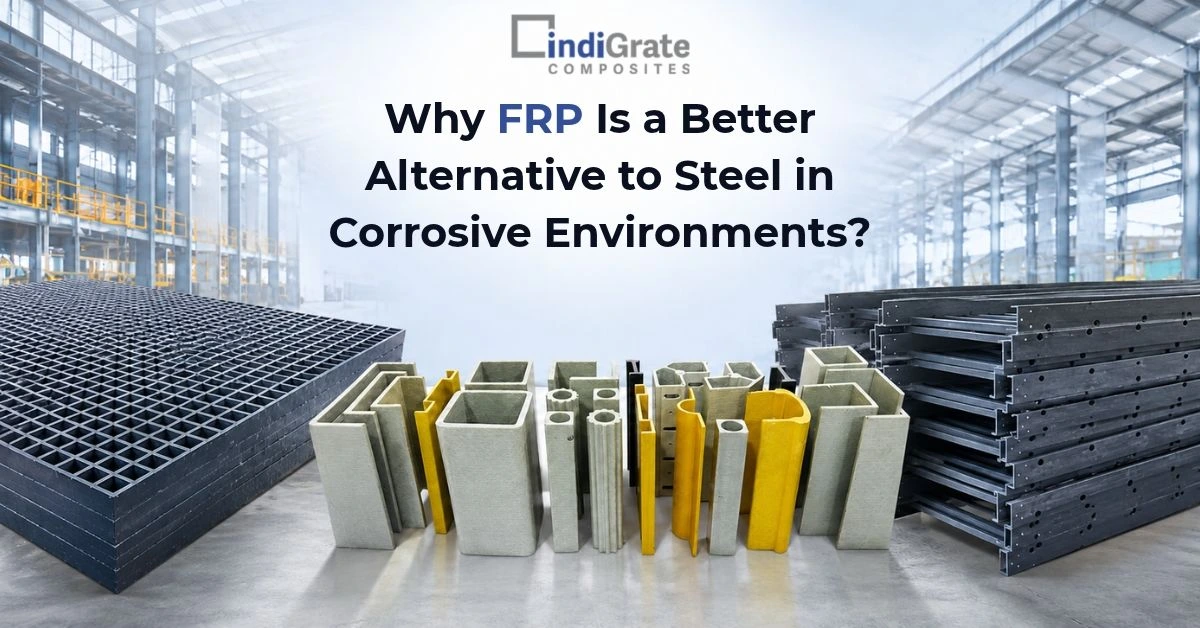
Steel is widely used in industrial structures, equipment supports, walkways, and infrastructure because of its strength and versatility. However, when exposed to moisture, chemicals, saltwater, or aggressive industrial atmospheres, steel can corrode over time. This deterioration may lead to frequent maintenance, protective coating repairs, equipment downtime, and eventual replacement.
Choosing the right material becomes especially important in chemical plants, wastewater treatment facilities, marine installations, and other environments where corrosion is a recurring concern. In such applications, FRP Products offer an alternative by combining fibre reinforcement with a polymer resin matrix to provide strength, low weight, and resistance to many corrosive substances.
Unlike conventional steel, FRP does not develop rust through the same electrochemical process. However, its performance still depends on the resin system, chemical exposure, temperature, structural loading, and manufacturing quality. Understanding these differences helps engineers and procurement teams decide when FRP is a practical choice for long-term industrial performance.
Why Corrosion Makes Steel Challenging in Industrial Environments?
Steel exposed to oxygen and moisture can undergo electrochemical corrosion. In industrial facilities, acids, alkalis, salts, and chemical fumes may accelerate deterioration, depending on the steel grade and operating conditions.
Common challenges include:
- Frequent maintenance: Damaged coatings may require inspection, surface preparation, and recoating.
- Structural deterioration: Corrosion can reduce the effective thickness of steel components and affect their load-bearing capacity.
- Operational disruption: Repairs may require restricted access or temporary shutdowns.
- Higher lifecycle costs: Protective coatings, inspections, labour, and replacement contribute to long-term expenditure.
Stainless steel and specialized protective systems can improve corrosion performance, but they may increase initial costs and still require careful material selection. In these situations, FRP Products can provide a practical alternative for suitable applications where reducing corrosion-related maintenance is a priority.
How FRP Resists Corrosive Exposure?
Fibre-reinforced plastic combines reinforcing fibres, commonly glass fibre, with a polymer resin that binds the reinforcement into a composite structure. The fibres provide mechanical strength, while the resin contributes to the material’s environmental and chemical resistance.
Unlike ordinary carbon steel, FRP does not rust. This makes it useful in environments where conventional metal components require regular corrosion protection.
Key advantages include:
- Resistance to rust: No iron-based rust formation under normal service conditions.
- Chemical compatibility: Appropriate resin systems can resist selected acids, alkalis, salts, and other chemicals.
- Lightweight construction: Lower component weight can simplify transportation, handling, and installation.
- Reduced maintenance: Corrosion resistance can reduce the need for rust removal and protective coating repairs.
- Electrical non-conductivity: Many FRP components are electrically non-conductive, which can be useful in suitable applications.
However, FRP is not immune to degradation. Chemical incompatibility, elevated temperatures, ultraviolet exposure, moisture ingress, or mechanical damage can affect performance. Selecting the correct resin and construction is essential when specifying FRP Products for demanding service conditions.
FRP vs Steel: Key Differences
The best material depends on the operating environment, mechanical requirements, and overall project cost. The following comparison highlights the main differences.
| Selection factor | FRP | Steel |
| Corrosion behaviour | Does not rust; chemical resistance depends on the composite system | Can rust or corrode without suitable protection |
| Weight | Generally lightweight | Generally heavier |
| Strength and stiffness | Depends on fibre orientation, profile, and design | Often offers high strength and stiffness |
| Maintenance | May reduce corrosion-related maintenance | May require coatings, inspections, and repairs |
| Electrical properties | Generally non-conductive | Conductive |
| Temperature performance | Limited by resin and composite specifications | Depends on grade and operating conditions |
| Initial cost | Varies by product and specification | Varies by grade, fabrication, and protection |
| Lifecycle cost | Can be favourable in corrosive environments | Depends on corrosion protection, maintenance, and service life |
This comparison is general rather than universal. Proper engineering calculations, material compatibility checks, and application-specific specifications are necessary before choosing either material.
Where FRP Can Be a Better Choice?
Certain industrial applications benefit particularly from materials that resist corrosion without requiring conventional rust protection. Properly specified FRP Products can be suitable for the following environments.
- Chemical processing plants: FRP process equipment, tanks, and compatible ducting can be designed for selected chemical services.
- Water and wastewater treatment: FRP moulded gratings can provide access walkways and platforms in moisture-prone areas.
- Electrical infrastructure: FRP cable trays can support cable routing where corrosion resistance and electrical non-conductivity are useful.
- Marine and coastal facilities: Suitable composite systems can resist saltwater-related corrosion.
- Industrial structures: Pultruded FRP profiles can be considered for frames, supports, and other structures where their mechanical properties meet design requirements.
The material must be matched to the actual operating conditions. For example, an FRP resin suitable for one chemical may not perform adequately with another, even at a similar concentration.
Looking for corrosion-resistant solutions for your industrial project? Contact us to explore suitable FRP options.
What to Check Before Replacing Steel with FRP?
Switching materials requires more than comparing weight or corrosion resistance. Engineers should evaluate the operating environment, component function, and long-term performance before choosing a suitable alternative.
Selecting the right FRP Products requires careful assessment of the following factors:
- Chemical exposure: Identify the chemicals, concentrations, contact duration, and possibility of splashes or immersion.
- Temperature limits: Confirm the operating and cleaning temperatures are within the composite system’s rated range.
- Load requirements: Check static and dynamic loads, span, deflection limits, support spacing, and impact risks.
- Fire and safety requirements: Verify applicable fire performance, electrical safety, and industry standards where required.
- Installation conditions: Review connections, supports, fasteners, access requirements, and compatibility with existing structures.
- Lifecycle cost: Compare purchase price, installation, inspections, maintenance, downtime, and expected replacement needs.
A suitable specification should include documented material properties and relevant test data. This helps ensure that the selected component meets both safety and service-life requirements.
Frequently Asked Questions
Why is FRP better than steel in corrosive environments?
FRP does not rust like carbon steel and can resist many chemicals when the correct resin system is selected. It can also reduce corrosion-related maintenance in suitable industrial applications.
Can FRP completely replace steel?
No. FRP is suitable for many corrosive environments, but steel may be preferable where specific strength, stiffness, temperature, or structural requirements demand it.
Do FRP products require regular maintenance?
FRP generally requires less corrosion-related maintenance than unprotected steel. However, periodic inspections are still necessary to identify cracks, surface damage, loose connections, or other signs of deterioration.
Are all FRP products resistant to chemicals?
No. Chemical resistance depends on the resin system, chemical concentration, temperature, and exposure duration. Material compatibility should always be verified before installation.
Are FRP products more cost-effective than steel?
FRP can offer long-term savings by reducing corrosion protection, maintenance, and downtime. Actual cost-effectiveness depends on the initial price, installation, operating conditions, and expected service life.
Conclusion
Corrosion can increase maintenance costs, disrupt operations, and shorten the service life of steel components. In suitable industrial applications, FRP Products offer a practical alternative through rust-free performance, lightweight construction, and resistance to many corrosive substances.
However, the right choice depends on chemical compatibility, temperature, loading, and structural requirements. Evaluating these factors alongside installation and maintenance costs helps determine whether FRP or steel is better suited to a project. With proper material selection and engineering, FRP can support reliable, long-term performance in demanding environments.
