Use FRP, Beat Corrosion



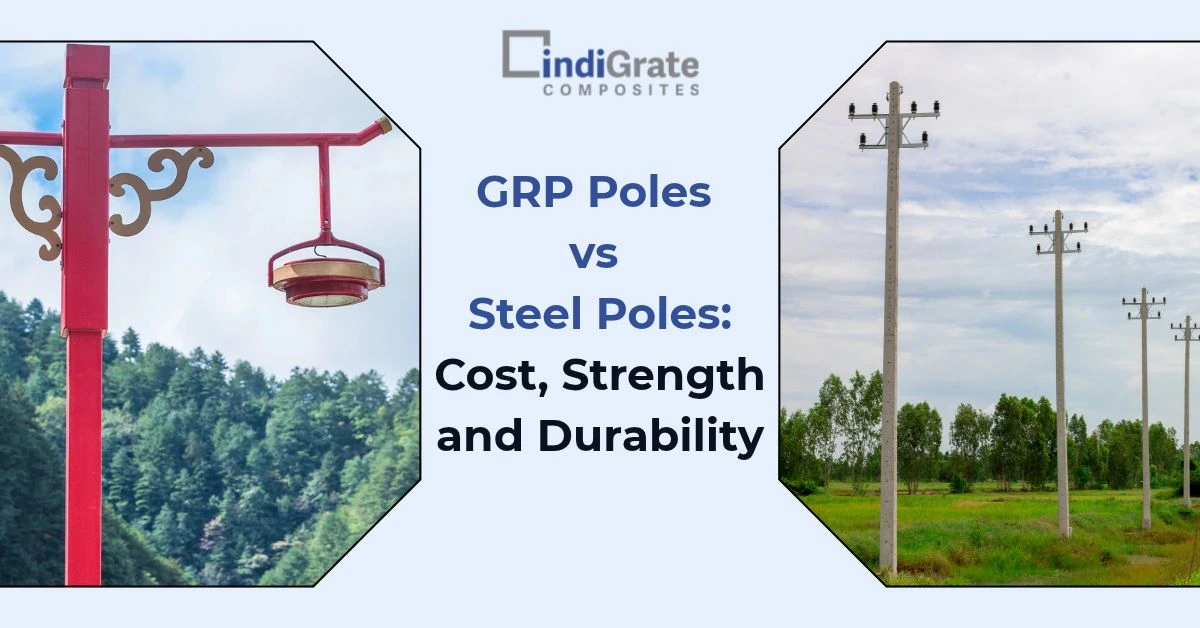
Choosing a pole material is not just about its buying price. You also need to think about how well it can handle strong winds, support lights and other equipment, and withstand the conditions where it will be installed. Steel poles have been used for many years in infrastructure projects, but they are not the only option available today. GRP (Glass Reinforced Plastic) poles are also being considered, especially for projects where rust resistance and lighter weight are important. Knowing the differences between steel and GRP Poles can help buyers choose the right material based on their project requirements, installation conditions, and long-term expenses.
1. Strength and Structural Performance
Steel is stiff and provides reliable support, which makes it a good choice for taller poles and installations carrying heavy equipment. GRP also offers good strength, but its performance can vary depending on how it is made. Factors such as fibre direction, resin type, reinforcement, and manufacturing quality all play a role in determining how well the pole performs.
An important difference is stiffness. While GRP Poles can withstand their designed loads, they may experience greater deflection than comparable steel poles. Therefore, selection should consider pole height, bending capacity, equipment weight, wind load, and permissible deflection rather than strength alone.
2. Durability and Corrosion Resistance
Steel poles can start to rust when their protective coating wears off or gets damaged. This is more common in places with salty air, high moisture, or industrial pollution. Areas around welds, joints, and the pole base may be more likely to develop rust. Galvanising and protective coatings help reduce this risk but require inspection and maintenance.
GRP does not rust because it contains no steel reinforcement. Its resistance to moisture and many corrosive substances makes GRP Poles suitable for coastal areas, chemical plants, and wastewater facilities. However, chemical compatibility depends on the resin system, temperature, and exposure conditions.
3. Wind Resistance and Deflection
Wind loading is a critical factor in pole design. Both materials must be engineered for the wind conditions at the installation site.
Steel poles are generally stiffer, so they tend to bend less under load. GRP poles can also provide good structural support, but their size and design need to be chosen carefully to keep bending within acceptable limits. Before selecting either material, buyers should ask for structural calculations. These should consider factors such as wind speed, pole height, exposed surface area, the weight of attached equipment, and ground or foundation conditions.
Looking for a suitable GRP pole solution? Contact us to discuss your project and product requirements.
4. Initial Cost vs Long-Term Cost
Steel often has a lower initial purchase price because of its established manufacturing and supply chain. GRP poles may cost more upfront, depending on specifications and production methods.
However, total project cost also includes transportation, installation, inspections, maintenance, repairs, and replacement. GRP’s lower weight can reduce handling requirements, while its corrosion resistance can reduce rust-related maintenance. Steel may remain more economical where corrosion is limited and protective systems are manageable.
5. Installation and Electrical Safety
GRP poles are lighter than steel poles of a similar size. This makes them easier to transport, unload, and move around at the installation site. In some cases, GRP Poles may also require smaller lifting equipment, depending on their size and site conditions. Steel poles are heavier, but their installation process is well known and commonly uses methods such as base plates and anchor bolts.
GRP is electrically non-conductive, which can be useful in electrically sensitive applications. However, this does not eliminate the need for appropriate electrical protection, grounding of relevant equipment, and compliant installation practices.
6. Which Pole Should You Choose?
The choice depends on the application and operating environment.
GRP poles may be suitable for:
- Coastal, humid, and chemically exposed locations.
- Projects where corrosion-related maintenance is a concern.
- Installations where lighter handling is beneficial.
- Applications requiring a non-conductive pole material.
Steel poles may be suitable for:
- Taller structures and heavier equipment.
- Applications where stiffness and controlled deflection are priorities.
- Projects where established installation methods and lower initial costs matter.
Always compare equivalent pole heights, wind loads, deflection limits, foundations, protective systems, and warranties before deciding.
Frequently Asked Questions
What is the main difference between GRP and steel poles?
GRP is lightweight, corrosion-resistant, and non-conductive. Steel offers higher stiffness and established structural performance.
Are GRP poles stronger than steel poles?
Not in every application. Performance depends on design, dimensions, reinforcement, loading, and deflection requirements.
Are GRP poles suitable for coastal areas?
Yes. They do not rust and can suit coastal installations, provided the resin and product specifications match the exposure conditions.
Do GRP poles require maintenance?
They do not need rust treatment, but periodic inspections remain important to identify surface ageing, impact damage, and connection issues.
Are GRP poles more expensive than steel poles?
They may have a higher initial price, but lower handling and corrosion-related maintenance costs can offer lifecycle advantages.
Conclusion
GRP and steel poles serve different project requirements. Steel is a practical choice where stiffness, established structural systems, and initial cost are priorities. For applications where corrosion resistance, lower weight, and electrical insulation matter, GRP Poles offer several advantages over conventional steel options. Comparing complete engineered solutions helps ensure reliable performance and better long-term value.